
Werner Hackl, arr: Fest-Fanfare für 3 Trompeten und 3 Posaunen, Pauken ad lib.
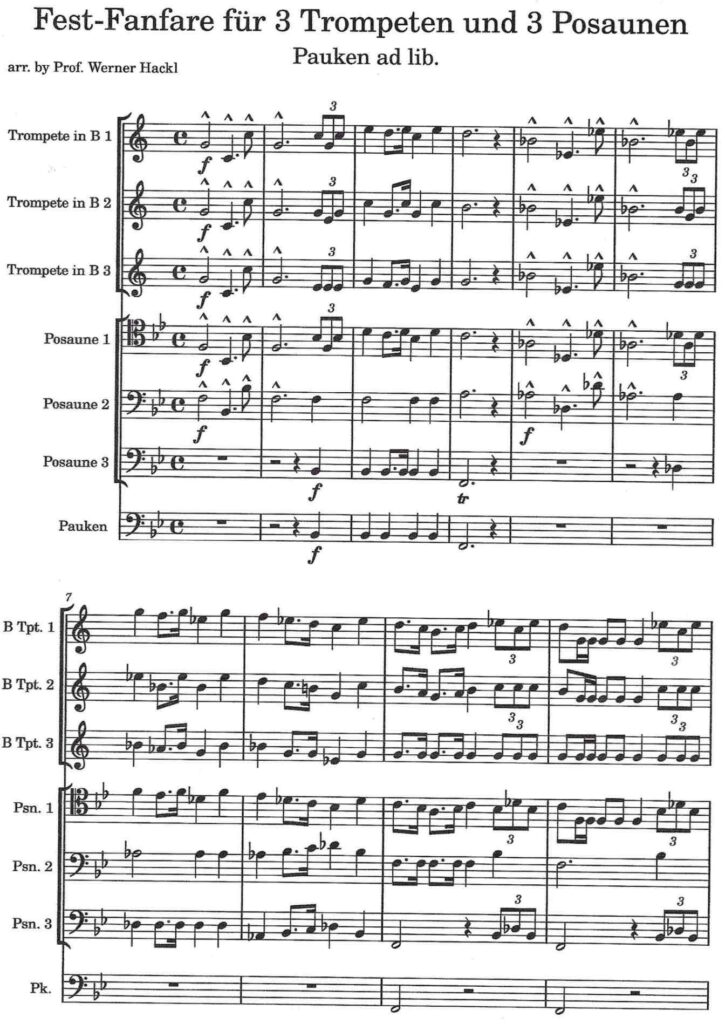
Der Begriff Fanfare stammt von dem arabischen Wort (farfar), daraus entwickelte sich im Französischen der Begriff farfarer “Trompeten blasen”. Unter einer Fanfare versteht man ein helltönendes, ventilloses trompetenartiges Instrument aber auch ein Musikstück für Trompeten, Hörner, Tuben und Pauken. Während ein Signal oder Tusch für ein kurzes Werk steht, versteht man unter einer Fanfare eine längere Komposition. Diese wird vornehmlich für Blechblasinstrumente verfasst, bei denen auf Naturtöne und Dreiklangsmotivik Bedacht genommen wird. Eine Fanfare ist stets eine klangreiche Komposition, die weitreichend zu hören ist. Claudio Monteverdi stellt am Beginn seiner Oper eine Toccata, eine Fanfare, die eine Aufmerksamkeit der Besucher bewirken soll.
The term fanfare comes from the Arabic word (farfar), from this, the French term farfarer, “to blow the trumpets,” evolved. A fanfare is a bright-sounding, valveless, trumpet-like instrument, but also a piece of music for trumpets, horns, tubas, and timpani. While a Signal or Tusch represents a short work, a fanfare is a longer composition. These are primarily composed for brass instruments, with a focus on natural tones and triad motifs. A fanfare is always a richly sonorous composition that can be heard over a wide area. Claudio Monteverdi begins his opera with a toccata, a fanfare intended to capture the audience’s attention.
| sound sample / Tonbeispiel | score/parts PDF download: € 12,- | add to cart / in den Warenkorb |