
Marc‘ Antonio Cesti (1623-1669) Intermezzo aus „Il Pomo d’ Oro“
Antonio Cesti, geboren in Arezzo, gestorben in Florenz, war ein italienischer Opernkomponist, Sänger und Hofkapellmeister. Als Franziskaner bekleidete er zunächst verschiedene kirchenmusikalische Ämter in Italien. 1652 setzte er seine ersten Opern in Venedig in Szene. 1652 bis 1657 wurde Cesti als Musikdirektor an der Privatkapelle von Ehz. Ferdinand Karl in Innsbruck angestellt. 1659 musste er sich auf Befehl des Franziskanerordens nach Rom begeben, wo er, vom Gelübde entbunden, in der Sixtinischen Kapelle sang und komponierte. In den Jahren 1665 bis 1667 wirkte er als Kapellmeister am Hof von Kaiser Leopold I. in Wien und komponierte dort für die Hochzeitsfeier des Kaisers seine wohl berühmteste Oper, Il pomo d’oro. Letztlich kehrte Cesti nach Italien zurück.
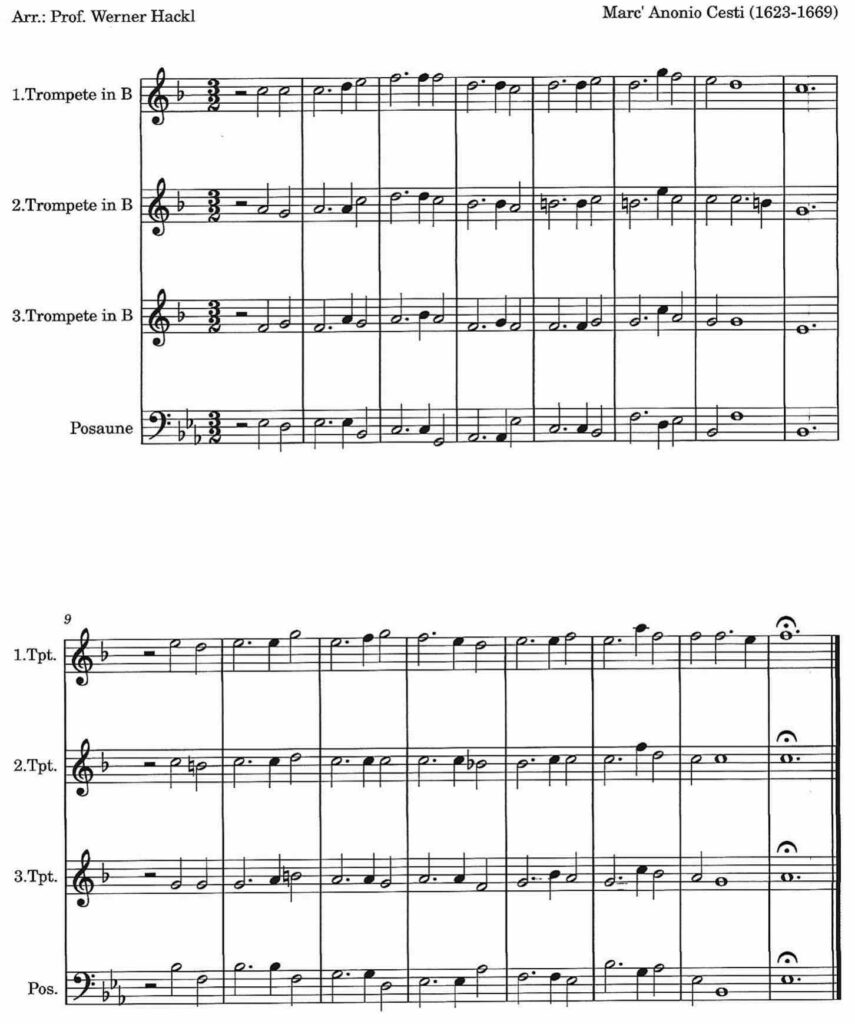
Cestis Festoper Il Pomo d‘ Oro (Der goldene Apfel) gehört zu den prunkvollsten Barockopern. Das düstere Intermezzo an der Höllenpforte aus dem 2. Akt der Oper ist für Blechbläser (2 Cornetti und 3 Posaunen) gesetzt.

Antonio Cesti, born in Arezzo, died in Florence, was an Italian opera composer, singer and court conductor. As a Franciscan, he initially held various church music positions in Italy. In 1652 he staged his first operas in Venice. From 1652 to 1657 Cesti was music director at the orchestra of Ehz. Ferdinand Karl employed in Innsbruck. In 1659, on the orders of the Franciscan Order, he had to go to Rome, where, released from his vows, he sang and composed in the Sistine Chapel. From 1665 to 1667 he worked as a Kapellmeister at the court of Emperor Leopold I in Vienna and composed what is probably his most famous opera, Il pomo d’oro, for the emperor’s wedding celebration. Ultimately Cesti returned to Italy.
Cesti’s festival opera Il Pomo d’ Oro (The Golden Apple) is one of the most magnificent baroque operas. The dark intermezzo at the Gates of Hell from the second act of the opera is scored for brass (2 cornetti and 3 trombones).
| sound sample / Tonbeispiel | score/parts PDF download: € 9,- | add to cart / in den Warenkorb |