
Franz von Suppé (1819-1895) Tuba mirum Aequale from Requiem
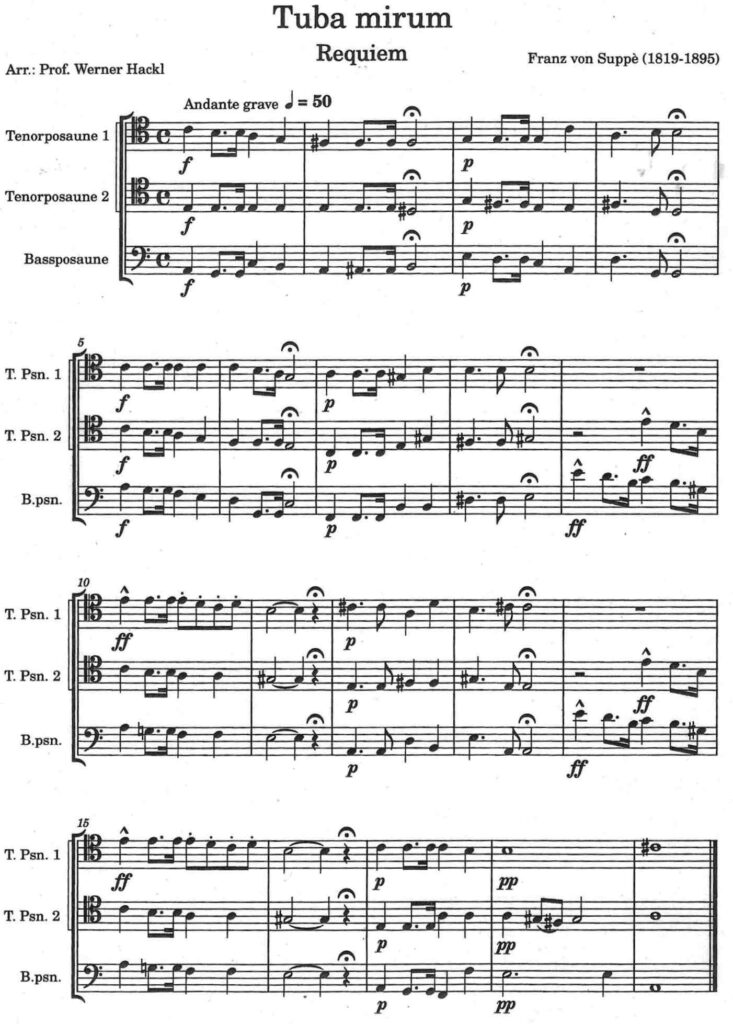
Franz von Suppè, geboren in Split, gestorben in Wien, gilt als Schöpfer der Wiener Operette, obwohl er auch Kirchenmusik verfasste. Mit 21 Jahren wurde Suppè Kapellmeister am Theater in der Josefstadt. Er fand in Franz Pokorny, dem Direktor des Theaters an der Wien, einen Freund und Förderer, der ihn 1845 als Kapellmeister an sein Haus verpflichtete. 1850 verstarb Pokorny, und zu dessen Gedächtnis schuf Suppé fünf Jahre später das Requiem in d-Moll (Missa pro defunctis) für vier Solostimmen, Chor und Orchester. Die Uraufführung erfolgte 1855 in einem Gedenkgottesdienst in der Wiener Piaristenkirche. Die Nummer 3, Tuba mirum, bildet den Glanzpunkt dieses Werkes. Es beginnt mit einem Posaunen-Trio, das die Toten aus den Gräbern zu erwecken scheint; man hört gleichsam, wie aus dieser Gegend die erste und aus jener die zweite, aus einer andern endlich die dritte Posaune rufend ertönt. Der Posaunensatz erinnert an das Aequale-Blasen bei Leichenbegängnissen sowie öffentlich am Allerseelentag. Von Beethoven und Bruckner sind einschlägige Kompositionen überliefert, wie auch an der besagten Stelle in Suppès Requiem.
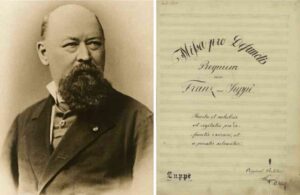
Franz von Suppè, born in Split and died in Vienna, is considered the creator of the Viennese operetta, although he also composed church music. At the age of 21, Suppè became Kapellmeister at the Theater in der Josefstadt. He found a friend and supporter in Franz Pokorny, the director of the Theater an der Wien, who appointed him Kapellmeister to his house in 1845. Pokorny died in 1850, and in his memory, Suppé composed the Requiem in D minor (Missa pro defunctis) for four solo voices, choir, and orchestra five years later. The premiere took place 1855, at a memorial service in the Piarist Church in Vienna. Number 3, Tuba mirum, is the highlight of this work. It begins with a trombone trio that seems to awaken the dead from their graves; one hears, as it were, the first trumpet calling from this area, the second from that, and finally the third from another. The trombone passage is reminiscent of the blowing of the aequale at funerals and publicly on All Souls’ Day. Relevant compositions by Beethoven and Bruckner have survived, also be found at the aforementioned point in Suppè’s Requiem.
| sound sample / Tonbeispiel | score/parts PDF download: € 12,- | add to cart / in den Warenkorb |